Planned round what the shops actually sell
Supermarkets don’t sell food for one person.
So we plan the other way round: 14 dinners built from what the shops actually stock — the 400g pack, the whole bunch, the tin you can’t buy half of — with every leftover ingredient landing in another meal that fortnight.
Takes about two minutes. No account, no card.
Or see three dinners free as a PDF first, without answering anything.
One of the fourteen, in full
Garlic Butter Gnocchi with Spinach and Cherry Tomatoes
20 minutes · about £3.50
Gnocchi cooks in minutes on the hob, and this uses the bag of spinach that reappears across the plan. A solid Italian start that needs just one pan.
Ingredients
- 400g Fresh gnocchiSupermarkets sell 400–500g packs; use what you need for one generous portion, roughly half a 500g pack, and keep the rest refrigerated — it turns up again later in the plan.
- 10–12 Cherry tomatoes
- 2 large handfuls Baby spinachBuy a 200g bag; the rest is used across three other dinners, so none of it goes off in the drawer.
- 2 cloves Garlic
- 25g Butter
- 1 tbsp Olive oil
- to season Salt and black pepper
- 20g, finely grated Parmesan
Method
- 1Halve the cherry tomatoes and finely slice the garlic.
- 2Put a large frying pan over medium-high heat and add the olive oil and half the butter.
- 3Add the gnocchi in a single layer. Leave them without stirring for 2–3 minutes until a golden crust forms on the underside, then toss and cook for another 2 minutes. They should be crisp in patches and heated through. Transfer to a bowl and set aside.
- 4Turn the heat to medium. Add the remaining butter and the garlic. Stir for about 60 seconds until the garlic is pale gold and smells nutty — not brown.
- 5Add the tomatoes. Cook for 3–4 minutes, pressing them gently so they start to break down and release their juices.
- 6Add the spinach in two batches, stirring each batch until wilted before adding the next.
- 7Return the gnocchi to the pan, toss everything together and season well with salt and pepper.
- 8Tip into a bowl and grate the parmesan over the top.
Leftovers. If you have a little sauce left in the pan, it keeps in the fridge for a day and makes a quick base for scrambled eggs.
That is one dinner from one person’s plan — written for someone who eats anything, has half an hour on a weeknight, and asked for more Italian food. Yours will be 14 dinners built round your answers, not these.
Get yours — it’s freeNothing goes soft in the drawer
Every ingredient that only sells in a pack too big for one has a named home for the rest, in another meal that fortnight.
The waste is where the money goes
Buying a bunch of coriander for one tablespoon is not a small cost when it happens every week.
No deciding at six o'clock
The fortnight is settled. You shop once, from a short list, and cook whatever is next.
Not the same thing for three days
Fourteen different dinners, each portioned for one — not one big batch stretched thin.
What actually arrives
A PDF of 14 dinners, one to a page, with a shopping list at the front. These are real pages from a real plan — not a mock-up. Yours will have different dinners in it.
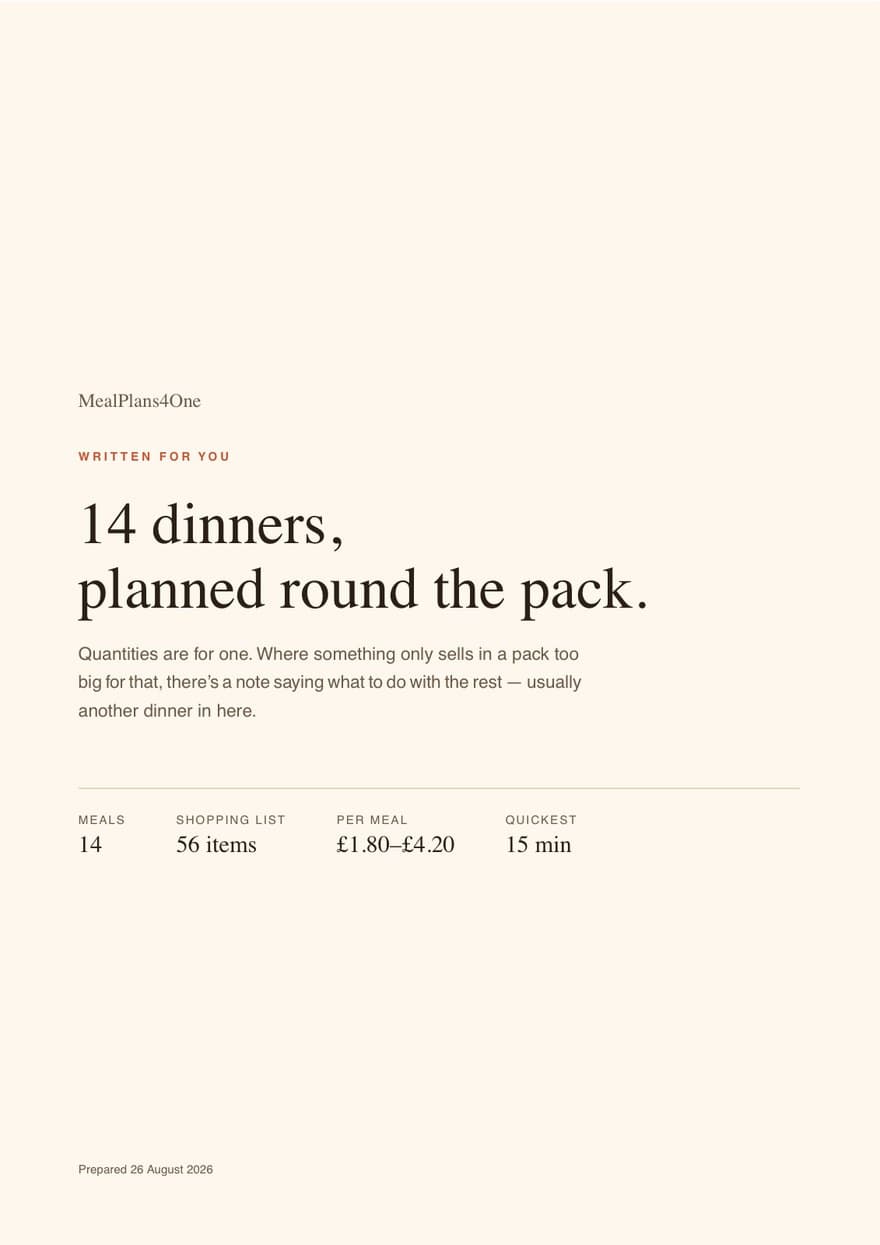
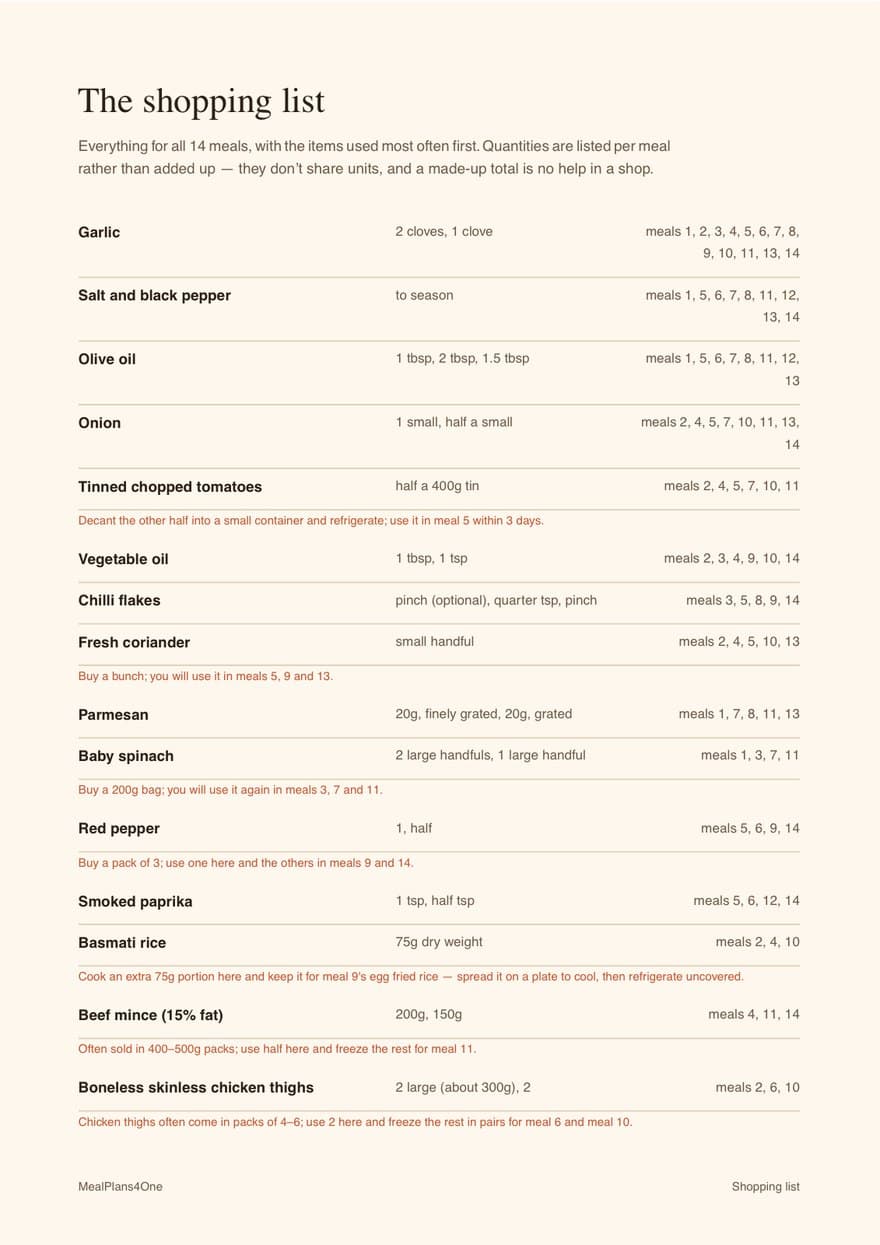
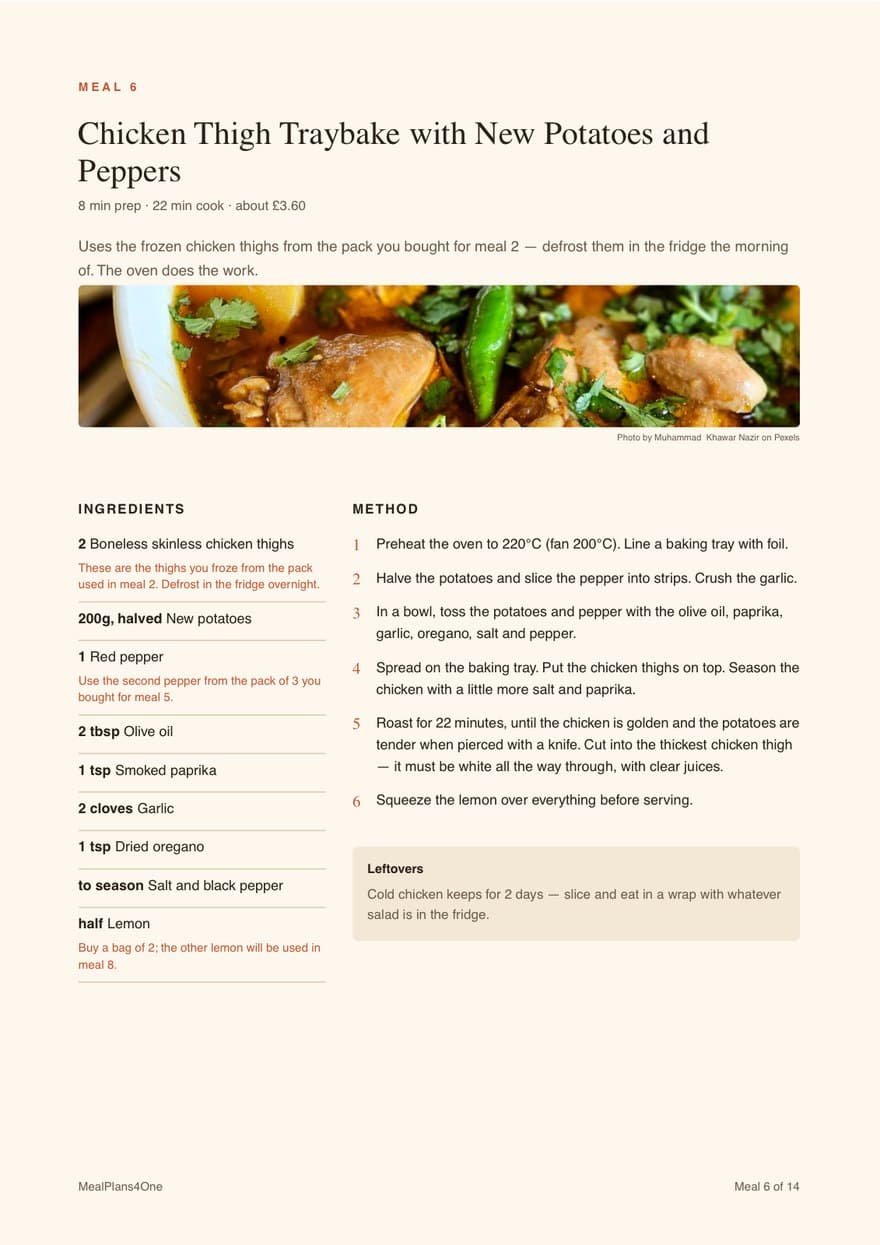
The cover, the shopping list, and one of the fourteen meal pages.
You can read three of these pages for yourself before paying anything — the free sample is the same PDF, cut to three meals.
How your plan is made
Your answers go to a language model — Claude, made by Anthropic — which writes the 14 recipes. It works to a long set of rules I wrote: quantities for one person, never a family recipe divided down; ingredients reused across the fortnight so the shopping list stays short; anything you list as an allergy or exclusion treated as absolute; and no health, diet or calorie claims anywhere.
Nobody cooks the recipes before you do, and no one reads your plan before it reaches you. It is written when you ask for it and sent straight to you. I am one person running this, not a test kitchen.
What that means when you cook
Treat the times and quantities as a good starting point rather than something proven in a kitchen. Taste as you go, and trust yourself over the page — if a pan looks dry or an onion is not soft yet, you are right and the recipe is a guess.
On allergies: what you list is treated as a hard boundary, including the places allergens hide — fish sauce, stock cubes, curry pastes. But no automated check is a substitute for reading the label on the packet in your hand, and if a reaction would be serious, please read it.
The photographs are stock pictures of similar dishes, chosen to match each recipe. They are not photographs of the food you will make.
If a plan comes back wrong — an exclusion missed, a method that makes no sense — reply to the email it arrives in. It comes to me.
What it costs
The questionnaire and your first meal are free. If you want the other 13, they come as a PDF you can keep — shopping quantities, methods, costs and leftover notes — for a one-off payment of £19.
£19 is an introductory price and it runs until 31 October. After that the plan is £29. There is no timer on this page — the date is simply the date.
One payment, not a subscription. Nothing recurring, nothing to cancel, and the PDF is yours to keep.
14 days to change your mind
If the plan is not what you wanted, email within 14 days and I will refund you in full. No questions, no explanation needed, and you keep the PDF — asking for it back would be theatre, since you have already downloaded it.
You are buying something written for you that nobody has cooked. That is a fair thing to be unsure about, so the risk sits with me rather than with you.
You see your first meal before paying anything.
This is a cooking product. It makes no health, diet or weight-loss claims, and there are no calorie or macro targets anywhere in it.